Notulae Diversitas
student circle
Notulae Diversitas – a student circle dedicated to all undergraduate, master’s and doctoral students, especially from the following faculties of USAMV Cluj-Napoca, or scientific and professional societies:
- Faculty of Horticulture and Business in Rural Development
- Faculty of Forestry and Cadastre
- Society of Horticulture and Forestry in Transylvania (SHST)
Location
- USAMV Cluj-Napoca,
- Faculty of Horticulture and Business in Rural Development (https://horticultura.usamvcluj.ro/)
- Faculty of Forestry and Cadastre (https://fsc.usamvcluj.ro/)
Circle Coordinator
- Prof. dr. Adriana F. SESTRAȘ – Biostatistics, experimental techniques, ecology
- [email protected]
Organizers – Academic staff active in the circle
- Conf. dr. Cătălina DAN – Botany
- [email protected]
- Conf. dr. Alina-Maria TRUȚĂ – Dendrology
- [email protected]
- Senior Researcher dr. Irina Maria MORAR – Biostatistics, experimental techniques, ecology + Law and legislation
- [email protected]
- Scientific Researcher CS III dr. eng. Gabriela ROMAN – Rose improvement and cultivation, Horticultural Research Station, USAMV Cluj-Napoca
- [email protected]
- Prof. dr. Radu E. SESTRAȘ – Plant breeding, biodiversity and bioconservation
- [email protected]
Note: All faculty members of the faculty can participate (and register on the circle’s page) and can support any student activity under the aegis of the circle or the society.
Affiliations – links with scientific and professional societies and associations (through faculty members)
- Transylvanian Society of Horticulture and Forestry (SHST)
- Rose Friends Association
- Other societies (SRH, ISHS, Eucarpia etc.)
Purpose of the circle
- Practical deepening of the knowledge acquired in the courses and practical work in the disciplines of botany, ecology, dendrology, plant breeding, etc. in the faculty’s curriculum (especially in the undergraduate programmes in Horticulture, Landscape Architecture and Forestry and the corresponding master’s programmes in the Horticulture–Landscape Architecture and Forestry departments).
- Deepening of scientific methods for the quantitative and qualitative assessment of biodiversity, through practical and field activities, as well as scientific investigation using appropriate methods, including through academic databases and information exchange with institutions and/or economic agents at home and abroad.
- Developing professional competencies and the ability to select, combine and appropriately use knowledge, skills and other acquisitions (values and attitudes), in order to successfully solve work or learning problems.
- Developing transversal competencies, through transdisciplinary abilities to integrate knowledge in accordance with the study programme and/or field, as well as from the perspective of making use of the knowledge and skills acquired.
- Developing teamwork skills, oral and written communication using specific terminology, information and communication technology, problem-solving and decision-making, as well as the capacity and openness towards lifelong learning, learning autonomy, initiative and entrepreneurial spirit, recognition, respect and development of diversity, values and professional ethics.
Proposed/carried-out activities
- Introduction to scientific research in the relevant field.
- Field investigations, excursions, field and laboratory practice.
- Investigations in academic databases based on proposed topics.
- Carrying out specialized practice and research activities.
- Initiating databases regarding collected information.
- Organizing round tables and presentations of scientific papers.
- Members’ participation in scientific communication sessions, workshops, etc.
- Participation in volunteer activities.
- Participation in cultural, sports, and social activities; support for humanitarian actions.
Facilities, support offered to members (students – bachelor’s, master’s, doctoral)
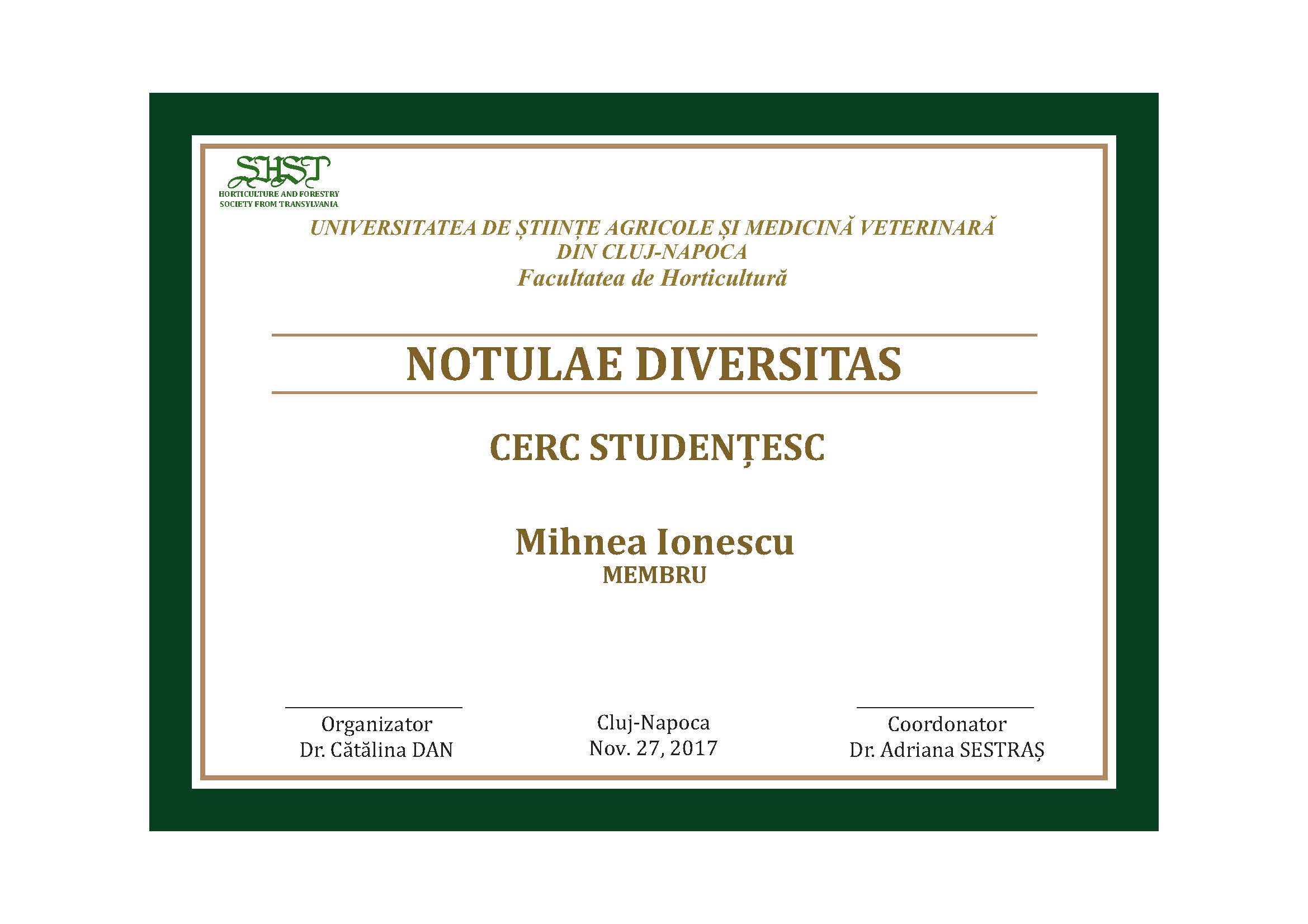
- Membership certificate, signed by the circle’s coordinator and organizer.
- Coverage of the fee – membership access to SHST (Society of Horticulture and Forestry in Transylvania).
- Introduction to editing and technical editing activities and training as editors (technical editors), through contributions to associated journals; issuance of certificates following the certification and recognition of the activity.
- Other opportunities.
Membership application
- Membership application – Word file – download.
- It can be filled out and submitted at office E3-14, 3rd floor, ICHAT (or completed electronically and sent by e-mail: [email protected]).
- After completing their studies, circle members may retain their status as ‘associates’.